
TCEQ Corrective Action at LPST Sites: What Soil, Groundwater & Vapor Assessments Actually Involve
If you’ve recently bought (or are about to buy) a piece of property that used to have an underground storage tank on it, and you just got a letter from TCEQ with an “LPST” number attached to your address, take a breath. It sounds scarier than it is – but only if you know what’s coming next.
We get calls about this a lot at CRG Texas, and honestly, the panic is understandable. Nobody explains this stuff in plain English. So let’s fix that.
What Is an LPST Case, Really?
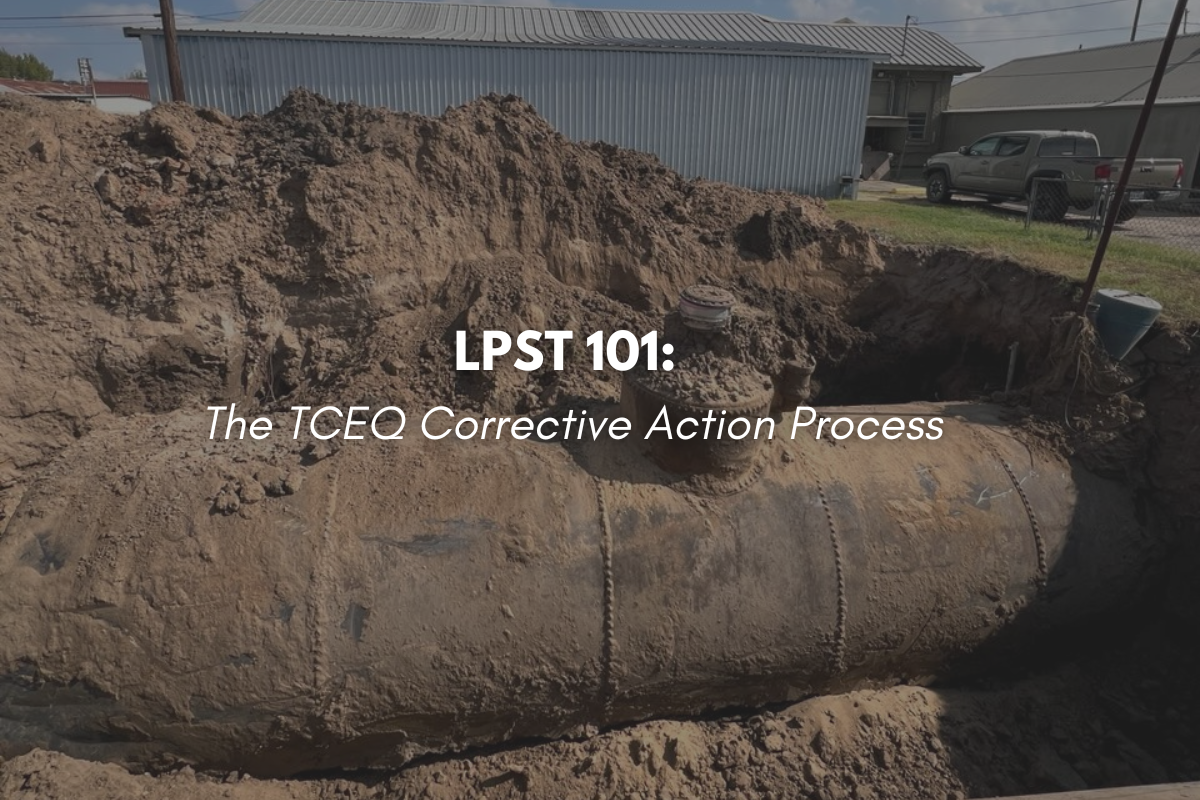
LPST stands for Leaking Petroleum Storage Tank. It’s the label the Texas Commission on Environmental Quality (TCEQ) slaps on a site once there’s confirmed or suspected evidence that a storage tank – usually an old gas station tank, a fleet fueling tank, or an industrial UST – has released petroleum into the soil or groundwater at some point in its life.
Here’s the thing people don’t realize: the tank doesn’t even have to still be there. We’ve worked sites where the tank was pulled out of the ground decades ago, but the contamination it left behind is still sitting in the soil, quietly waiting to become somebody else’s problem. That “somebody else” is often a buyer who had no idea what they were purchasing until a Phase 1 Environmental Site Assessment turned up a red flag.
Once TCEQ assigns a site an LPST number, it’s no longer optional. The property is now in the Petroleum Storage Tank (PST) program, and the responsible party – which might be you, the current owner, depending on how your purchase agreement was written – has to move through a defined process before the case can be closed.
That process is called TCEQ Corrective Action, governed by what’s known as Risk-Based Corrective Action, or RBCA.
So What Does “Risk-Based” Actually Mean?
This part trips people up. “Risk-based” doesn’t mean TCEQ is being lenient. It means the cleanup requirements are scaled to the actual danger the contamination poses – not to some flat, one-size-fits-all standard.
Think of it like a doctor triaging patients in an ER. A scraped knee and a broken leg don’t get the same treatment plan, even though both technically involve an injury. Same logic here: a site with contamination sitting 40 feet down, nowhere near a water well or an occupied building, gets handled very differently than a site where vapors could be creeping into somebody’s basement.
RBCA exists so that low-risk sites can move toward closure faster, while genuinely dangerous sites get the scrutiny they need. It’s actually a more efficient system than it sounds like on paper – but only if the site is assessed correctly from the start, which is where most of the real work (and most of the delays we see) happens.
The Three Assessments TCEQ Requires
Every LPST case run through RBCA involves evaluating three separate pathways: soil, groundwater, and vapor. Each one answers a different question about where the contamination went and who or what it could affect.
Soil Assessment
This is usually where the investigation starts, since it’s the most direct evidence of a release. Crews collect soil samples – often through direct-push borings – at and around the suspected source area (the old tank pit, the piping runs, the dispenser islands if it was a gas station).
The lab results get compared against TCEQ’s action levels. If concentrations of petroleum-related compounds like benzene, toluene, or naphthalene come back above those thresholds, the soil pathway stays open and needs to be delineated – meaning you have to map out exactly how far the contamination spreads, both sideways and down.
We had a site a while back where everyone assumed the contamination was contained to a tight radius around the old tank pit, based on a decades-old report. Turned out the plume had migrated with groundwater flow toward a property line nobody had checked. That’s the kind of thing that turns a “quick closure” into a much bigger project – which is exactly why the assessment phase matters so much.
Groundwater Assessment
If soil contamination is present, the next question is whether it’s reached groundwater – and if so, how far it’s moved and whether it threatens a drinking water source or a nearby well.
This involves installing monitoring wells and sampling them, sometimes on a recurring schedule (quarterly or semi-annually, depending on the site) to track whether the plume is stable, shrinking, or still spreading. TCEQ has specific groundwater monitoring and reporting guidance for exactly this (RG-523/PST-06, if you want to get technical), and it’s one of the more time-consuming parts of the process because groundwater doesn’t sit still – it moves with the water table, seasonal rainfall, and nearby pumping activity.
This is usually the phase clients ask the most questions about, mainly because it’s the one most likely to stretch a closure timeline out by months or years if the plume is actively migrating.
Vapor Assessment
The newest – and honestly most misunderstood – piece of the puzzle is vapor. Petroleum contamination in soil or groundwater can off-gas and migrate upward through the soil column, potentially entering buildings through cracks in foundations or utility penetrations. This is called vapor intrusion, and it’s a big deal if there’s an occupied structure (or a planned one) sitting on or near the plume.
Vapor assessments typically involve soil gas probes and sub-slab or indoor air sampling to see whether contaminant vapors are reaching – or could reach – breathable air inside a building. If the site is a vacant lot with no structures planned, this pathway might screen out quickly. If it’s a property somebody wants to build a daycare or an apartment complex on, TCEQ is going to want a much closer look.
How TCEQ Decides When a Site Is Ready to Close
Once all three pathways – soil, groundwater, and vapor – have been evaluated, TCEQ runs the site through what’s called the exit criteria process. Essentially, they’re checking each pathway against a flowchart of conditions: Is contamination above action levels? Are there active receptors (wells, buildings, surface water) nearby? Is the plume stable or shrinking?
Sites that screen clean, or where the risk has been reduced to an acceptable level, can move toward a Site Closure Request – the official form and documentation package submitted to TCEQ asking them to close the case. Sites that don’t screen out that easily move into a more detailed corrective action plan, which might involve active remediation (things like soil excavation, groundwater treatment, or vapor mitigation systems) before closure becomes realistic.
It’s worth saying clearly: not every site needs years of remediation. A lot of LPST cases, especially smaller ones with limited contamination, can move through this process in a matter of months if the initial assessment is done thoroughly and the paperwork is clean. The delays we see almost always trace back to incomplete delineation early on – meaning the investigation didn’t answer TCEQ’s questions the first time, and now there’s a second (or third) round of sampling to fill in the gaps.
What This Means If You’re Sitting on an LPST Case Right Now
If you’ve just found out your property has an LPST number attached to it, here’s the honest, non-scary version of what’s ahead:
- Someone needs to evaluate soil, groundwater, and vapor conditions at the site
- TCEQ will compare the results against risk-based action levels
- Depending on what’s found, the site either moves toward closure or into a more detailed corrective action plan
- The whole thing is managed by a licensed corrective action project manager working under TCEQ’s guidance documents
None of that has to be a mystery, and it definitely doesn’t have to be handled reactively. The sites that close fastest are the ones where the assessment was done right the first time – thorough sampling, proper delineation, and reporting that answers TCEQ’s questions before they have to ask twice.
That’s the part we specialize in at CRG Texas: taking a site from “we just got an LPST letter” all the way through to closure, without the back-and-forth that eats up months of everyone’s time. If you’re dealing with an LPST case – new or one that’s been sitting open for a while – we’re happy to take a look and tell you honestly where things stand.